Xiaomi Bets Big: Profits Drop 42% Amid Massive Chip Investment
Chinese tech giant Xiaomi has taken a bold path despite economic pressures. Specifically, the company faces general inflation, intense market competition, and rising component costs while pushing its new Xring O3 processor into production. As a result, its adjusted net profit dropped significantly by 42.6% year-on-year down to 6.219 billion yuan. However, the tech giant continues accelerating its self-developed semiconductor program to secure long-term independence.
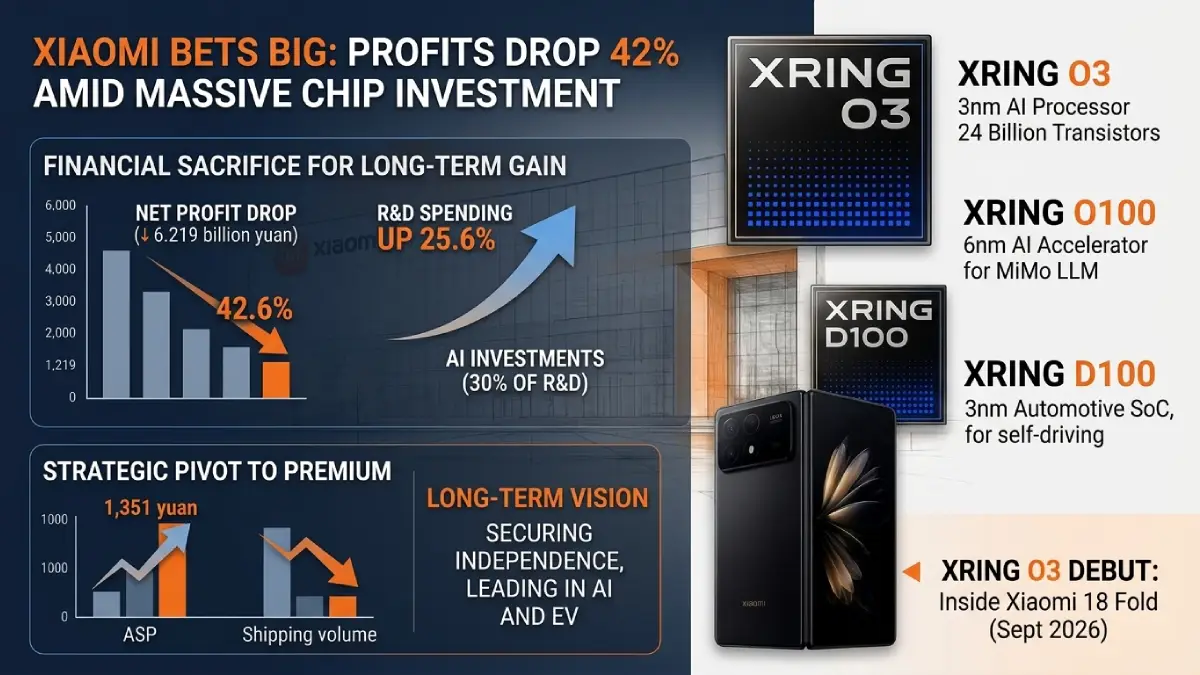
According to financial reports, Xiaomi’s total R&D spending grew by 25.6% in the first half of the year. Furthermore, artificial intelligence investments already represent nearly 30% of that total. Consequently, building proprietary silicon like the flagship Xring O3 remains a top strategic priority over immediate short-term profits.
New Xring O3 Chip and the Xiaomi 18 Fold Debut
Xiaomi officially introduced its next generation of proprietary processors built to handle complex tasks. The main highlight among these breakthroughs is the Xring O3, an advanced 3-nanometer AI processor boasting 24 billion transistors. Tech enthusiasts will see the Xring O3 debut next month inside the highly anticipated Xiaomi 18 Fold foldable smartphone.
Along with the flagship mobile processor, Xiaomi unveiled two additional specialized silicon solutions:
- Xring O100: A 6nm AI accelerator designed to enhance Xiaomi’s MiMo large language model alongside the Xring O3.
- Xring D100: A specialized 3nm automotive entry in the lineup built for self-driving vehicles.
Both the O100 and D100 chips are scheduled for commercial deployment next year across various smart devices.
Why Proprietary Silicon Matters in the AI Era
Developing in-house hardware requires massive capital, but industry experts emphasize its necessity. According to Ivan Lam, senior analyst at Counterpoint Research, Xiaomi now ranks among the top-tier Chinese companies designing mobile systems-on-a-chip (SoCs).
As modern AI workloads grow more complex on smartphones and electric vehicles, relying heavily on external suppliers creates major risks. Therefore, investing heavily in the Xring O3 architecture at a loss now builds an undeniable competitive advantage later. Similar long-term strategies previously paid off for industry leaders like Apple, Huawei, and Samsung.
Rising Component Costs and Shift to Premium Devices
The overall smartphone market is currently facing severe structural challenges. Analysts at Omdia point out that over half of Xiaomi’s device shipments consist of budget models under $200. Consequently, rising component costs squeeze gross profit margins down to 8.5%, compared to 11.5% in the previous year.
To offset these compressed margins, Xiaomi has aggressively pivoted toward premium flagships powered by advanced hardware like the Xring O3. Although overall shipping volume dropped by 26.5%, the company’s average selling price reached a record 1,351 yuan per unit. Official financial documentation from Xiaomi Investor Relations highlights this shift toward high-margin premium hardware.
Financial Leadership and Long-Term Vision for Xring O3
While a sharp drop in quarterly net earnings might worry some investors, Xiaomi’s leadership remains calm. Alain Lam, Vice President and CFO of Xiaomi, emphasized that large-scale technology investments do not yield immediate financial returns.
Management views current capital deployment into AI and Xring O3 silicon as essential ground infrastructure. Therefore, the company has no intention to rush monetization while building out its next-generation ecosystem.
Final Verdict
Overall, Xiaomi’s strategy demonstrates clear long-term vision in a tough economic climate. By prioritizing proprietary Xring O3 chips and advanced AI capabilities over short-term quarterly profits, Xiaomi is establishing itself as an independent tech powerhouse capable of leading both the mobile and EV sectors.